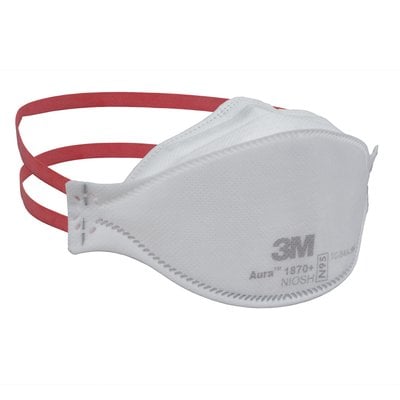
3M™ Aura™ 1870+ N95 Health Care Particulate Respirator & Surgical Mask - Box of 20
SKU: HMS-001
$58.95 incl. GST
NIOSH-certified 3M Aura 1870+ N95 health care particulate respirator and surgical mask with >99% BFE and 160 mmHg fluid resistance. Unvalved, flat-fold design. Box of 20.
Key features
NIOSH-certified N95 particulate respirator
Bacterial Filtration Efficiency (BFE) >99% according to ASTM F2101
Fluid resistant according to ASTM F1862 at 160 mmHg
Designed to function as both a particulate respirator and surgical mask
Three-panel Aura flat-fold design
Adjustable mouldable nose clip supports seal and fit
Upper panel and nose design help reduce eyewear fogging
Red head straps identify the health care model
Contains no components made from natural rubber latex
Individually packaged for hygienic storage before use
The 3M Aura 1870+ is a disposable N95 health care particulate respirator and surgical mask designed to help reduce wearer exposure to certain airborne particles while also providing fluid resistance against splash and spatter of blood and other infectious materials. It combines the three-panel Aura flat-fold design with an adjustable nose clip, soft nose foam and red head straps for health care identification. Each respirator is individually packaged before use.
Brand3M
Product typeN95 health care particulate respirator and surgical mask
Pack sizeBox of 20
StyleFlat-fold / headband / unvalved
Store SKUHMS-001
Packed weight0.3 kg
Standards & classification
NIOSH-certified N95 respirator. 3M states Bacterial Filtration Efficiency (BFE) >99% according to ASTM F2101 and fluid resistance according to ASTM F1862 at 160 mmHg. 3M Australia states that the respirator should be selected and used in accordance with AS/NZS 1715:2009. Australian health-sector reference material lists the 1870+ under ARTG ID 255656. NIOSH approval number: TC-84A-5726.
Fit & sizing guidance
The 1870+ is a standard-size, tight-fitting headband respirator. An effective face seal is essential. The three-panel flat-fold design is intended to accommodate facial movement, while the adjustable nose clip and nose foam assist positioning around the nose and cheeks. Facial hair or other conditions that interfere with the sealing surface can prevent an adequate seal. Where respiratory protection is required in a workplace, respirator selection and fit testing should form part of the applicable respiratory protection program.
Directions for use
Before fitting, ensure hands are clean and inspect the respirator and its components for damage.
1. Open the flat-fold respirator fully so the upper and lower panels form the facepiece.
2. Hold the respirator with the nosepiece uppermost and position it under the chin.
3. Pull the headbands over the head. Position the upper band on the crown of the head and the lower band below the ears. Do not twist the straps.
4. Adjust the upper and lower panels so the respirator sits comfortably and the chin panel is fully unfolded.
5. Using both hands, mould the nose clip around the nose and cheeks to help achieve a close fit.
6. Perform a user seal check before entering the area where respiratory protection is required.
Always read and follow the current 3M user instructions supplied with the respirator.
Warnings & use limitations
Proper respirator selection, training, fitting and use are essential. Read and understand the manufacturer user instructions before use.
Inspect the respirator before each use and discard it if damaged, soiled or otherwise unsuitable for use.
A tight facial seal is required for effective respiratory protection.
Facial hair in the sealing area can interfere with the face seal.
The respirator is intended to reduce exposure to certain airborne particles; it does not eliminate exposure or replace other PPE that may be required.
As a surgical mask, the 1870+ is designed to resist splash and spatter of blood and other infectious materials.
Respiratory protective equipment should be selected by a competent person with knowledge of the actual working conditions and equipment limitations.
Misuse of a respirator can result in sickness or death.
Do not use for
Gases or vapours.
Oxygen-deficient atmospheres.
Unknown contaminant concentrations or conditions immediately dangerous to life or health.
Any application outside the limitations stated in the current 3M packaging and user instructions.
Do not assume that N95 particulate filtration provides protection against every respiratory hazard.
Storage
Keep unused respirators in their original individual packaging and outer box in clean, dry storage conditions. Check the expiry/use-by information printed on the product packaging before use and follow any storage temperature and humidity limits stated by 3M on the current packaging or user instructions.
Specifications
Brand3M™
ModelAura™ 1870+
Product typeHealth care particulate respirator and surgical mask
Filter classN95
NIOSH certificationN95
NIOSH approval numberTC-84A-5726
Bacterial Filtration Efficiency>99% according to ASTM F2101
Fluid resistanceASTM F1862 at 160 mmHg
Exhalation valveNo
Respirator styleFlat fold / three panel
Respirator sizeStandard
Head strapsRed
Natural rubber latex componentsNo
Product colourWhite
Pack sizeBox of 20
Individual packagingYes
Australian ARTG reference255656
Frequently asked questions
Is the 3M Aura 1870+ an N95 respirator?
Yes. 3M identifies the 1870+ as a NIOSH-certified N95 health care particulate respirator.
Is the 1870+ also a surgical mask?
Yes. 3M describes the 1870+ as both a particulate respirator and surgical mask. It is fluid resistant according to ASTM F1862 at 160 mmHg and has BFE >99% according to ASTM F2101.
Does the 3M 1870+ have an exhalation valve?
No. The 1870+ is an unvalved respirator.
Is each 1870+ individually wrapped?
Yes. The respirators are individually packaged before use.
What is the difference between the 1870+ and the 9320A+?
Both use the 3M Aura three-panel flat-fold format, but they are intended and classified differently. The 1870+ is a NIOSH-certified N95 health care particulate respirator and surgical mask with 160 mmHg fluid resistance and >99% BFE. The 9320A+ is an unvalved P2/FFP2 particulate respirator and should not be assumed to have the same surgical-mask or fluid-resistance claims.
Can facial hair affect the fit of the 1870+?
Yes. Facial hair in the sealing area can prevent a tight face seal and reduce the protection provided by a tight-fitting respirator.
Does an N95 respirator protect against gases and vapours?
No. The N95 classification relates to particulate filtration and does not provide protection against gases or vapours.
Important product information
Respirator selection, fit and use depend on the hazard, workplace conditions and the wearer. Read and follow the manufacturer’s instructions supplied with the product. Where respiratory protection is required for work, follow the applicable workplace respiratory protection program and fit-testing requirements.