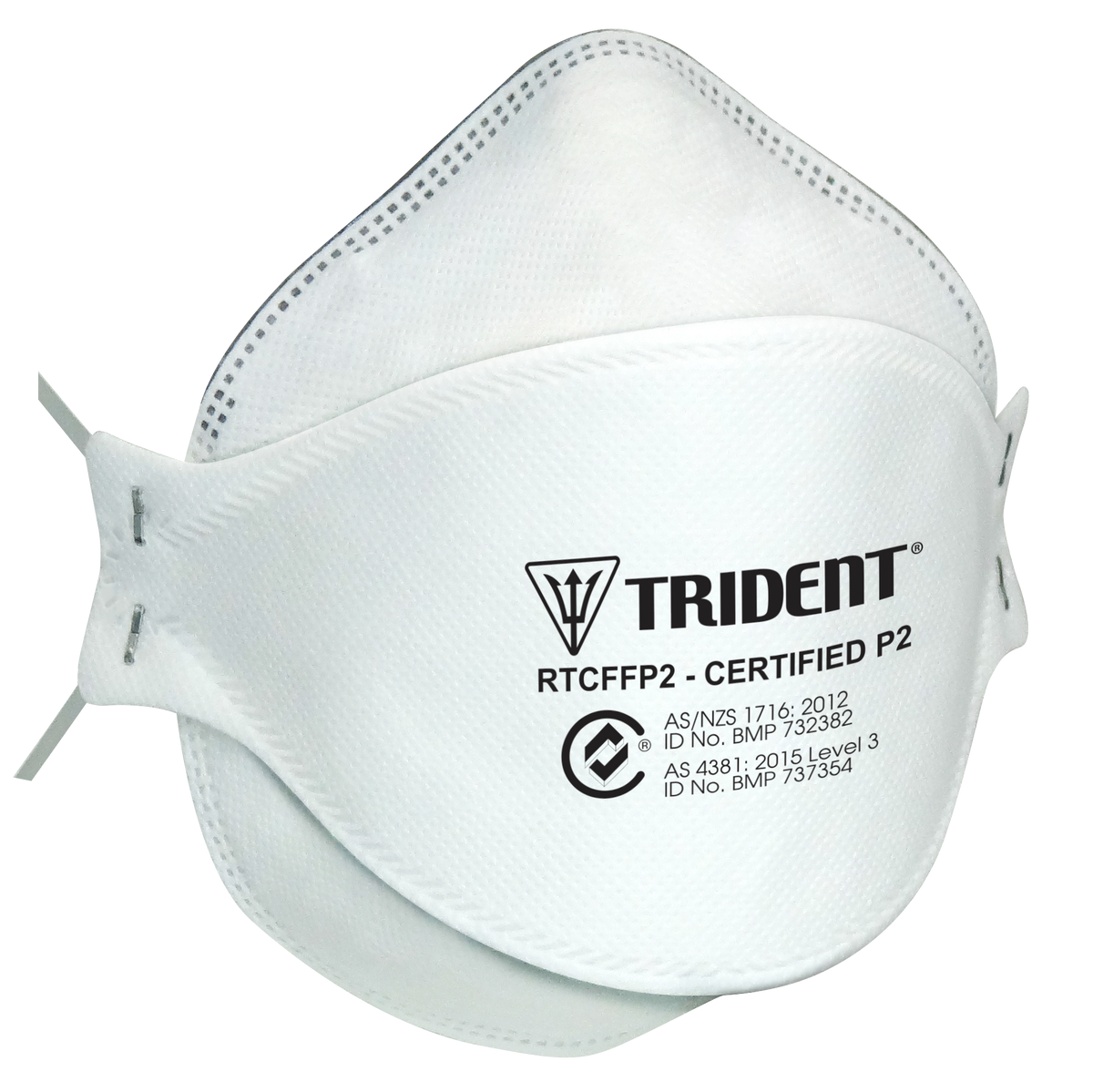
Australian-made Trident P2 Level 3 surgical respirator with three-panel construction, headband fit, soft nose foam and 160 mmHg fluid resistance. Available in multiple sizes and a Regular extended-head-strap option.
Key features
Certified P2 particulate respirator
AS 4381:2015 Level 3 fluid resistance
160 mmHg fluid resistance
Three-panel flat-fold construction
Headband design supports a secure facial fit
Soft nose foam for comfort and fit
Adjustable nose area assists facial sealing
Designed to help reduce eyewear fogging
Low breathing resistance
Structured design helps resist collapse during wear
Latex-free construction
Non-sterile
Unvalved design
Individually packaged respirators
Multiple fitting options available
Extra Small, Small, Regular and XX Large size options
Regular option also available with extended length head straps
The Trident P2 Level 3 Surgical Respirator is a close-fitting disposable respirator designed for applications where both particulate respiratory protection and high-level fluid resistance are required. Certified to the Australian P2 respirator standard and tested to Level 3 surgical mask requirements, it combines a three-panel flat-fold design with headband straps, soft nose foam and an adjustable nose area to support a secure and comfortable facial seal. The structured three-panel construction is designed to accommodate facial movement while maintaining its shape during wear and providing low breathing resistance. HMS offers multiple fitting options including Extra Small, Small, Regular, Regular with an extended length head strap, and XX Large.
The Trident P2 Level 3 Surgical Respirator is certified as a P2 respirator to AS/NZS 1716:2012.
Australian distributor documentation identifies certification ID BMP 732382 for AS/NZS 1716:2012.
The respirator is independently tested and certified to AS 4381:2015 Level 3, including 160 mmHg fluid resistance, with certification ID BMP 737354.
Distributor information also states independent testing and certification to ISO 22609.
The product is listed on the Australian Register of Therapeutic Goods (ARTG) under ARTG number 344154.
P2 is the Australian respirator classification used by HMS for this product. References by retailers to P2/N95 terminology should not be interpreted as an HMS claim of separate NIOSH N95 certification unless such certification is specifically documented for the exact product.
Fit & sizing guidance
The Trident P2 Level 3 respirator is available from HMS in Extra Small, Small, Regular and XX Large sizes. A Regular version with extended length head straps is also available for customers who require additional head-strap length while retaining the Regular respirator size.
Choosing an appropriate size is important because a tight-fitting respirator must form an effective seal against the face. The three-panel construction is designed to conform to the face while accommodating movement during speaking and normal facial movement.
The headbands distribute holding pressure around the head rather than relying on ear loops, while the soft nose foam and adjustable nose area assist comfort and sealing around the nose.
Facial hair or other objects within the respirator sealing area can interfere with the seal and reduce respiratory protection.
Check the fit and seal each time the respirator is worn. Where respiratory protection is required occupationally, appropriate respirator selection and fit testing should form part of the workplace respiratory protection program in accordance with applicable requirements.
Directions for use
Read and follow the current Trident manufacturer instructions supplied with the respirator.
Before fitting, clean your hands and inspect the respirator, headbands and nose area for damage or contamination.
1. Select the appropriate Trident variant for the wearer.
2. Remove the respirator from its individual packaging.
3. Open the three-panel respirator fully by separating the upper and lower panels.
4. Position the respirator over the nose, mouth and chin with the nose section uppermost.
5. Pull the headbands over the head and position them according to the manufacturer fitting instructions without twisting the straps.
6. Adjust the upper and lower panels so the respirator sits comfortably against the face and beneath the chin.
7. Using both hands, shape the nose area around the bridge and sides of the nose.
8. Check the complete facial seal before entering an area where respiratory protection is required.
9. If leakage is detected around the edges, reposition the respirator and straps and repeat the seal check.
This is a disposable respirator. Discard and replace it if damaged, contaminated, difficult to breathe through or otherwise unsuitable for continued use.
Warnings & use limitations
Correct respirator selection, sizing, fitting and use are essential.
A tight facial seal is required for effective particulate respiratory protection. Facial hair or other objects within the sealing area can interfere with the seal.
Inspect the respirator before each use. Do not use if damaged, contaminated or if the headbands or sealing surfaces are compromised.
The Level 3 fluid-resistance classification does not remove the need to select respiratory and other personal protective equipment appropriate to the actual hazard.
Do not assume protection against gases or vapours. This product is a particulate respirator and should only be used within the limitations stated by the manufacturer.
The respirator is non-sterile and disposable.
Do not use in oxygen-deficient atmospheres, unknown contaminant concentrations or environments immediately dangerous to life or health.
Workplace respiratory protection should be selected and managed by appropriately competent personnel in accordance with applicable occupational health and safety requirements.
Incorrect selection, sizing, fitting or use can significantly reduce respiratory protection.
Do not use for
Oxygen-deficient atmospheres.
Unknown contaminant concentrations or conditions immediately dangerous to life or health.
Gases or vapours unless the manufacturer specifically states suitability for the particular application.
Use where facial hair or another obstruction prevents an adequate facial seal.
Use where an appropriate size cannot achieve an adequate facial seal.
Sterile applications requiring a sterile respirator; this product is supplied non-sterile.
Reuse where the respirator has become damaged, contaminated or otherwise unsuitable.
Any application outside the current Trident manufacturer instructions or applicable workplace respiratory protection requirements.
Storage
Store unused Trident respirators in their original individual packaging and outer box in a clean, cool and dry environment. Protect from contamination, excessive moisture, direct sunlight, extreme temperatures and physical damage. Check the expiry date and any specific storage conditions printed on the current manufacturer packaging before use.
Specifications
BrandTrident
Product typeP2 Level 3 surgical respirator
Available HMS variantsExtra Small, Small, Regular, Regular Extended Length Head Strap, XX Large
Respirator classificationP2
Respirator standardAS/NZS 1716:2012
AS/NZS 1716 certification IDBMP 732382
Surgical mask classificationLevel 3
Surgical mask standardAS 4381:2015
AS 4381 certification IDBMP 737354
Fluid resistance160 mmHg
Additional test standard stated by distributorISO 22609
ARTG number344154
Respirator styleThree-panel flat fold
Head attachmentHeadbands
Extended strap optionRegular size available with extended length head straps
Exhalation valveNo
Nose comfortSoft nose foam
LatexLatex free
SterilityNon-sterile
Individual packagingYes
DisposableYes
Country of manufactureAustralia
Frequently asked questions
What sizes of Trident respirator does HMS offer?
HMS offers Extra Small, Small, Regular and XX Large variants. A Regular respirator with extended length head straps is also available.
What is the Regular Extended Length Head Strap option?
This option retains the Regular respirator size but provides extended length head straps. It appears as a separate HMS variant so customers can select it directly when ordering.
Which Trident respirator size should I choose?
Fit varies between individuals, so the best size is the one that provides an appropriate close facial seal for the wearer. HMS offers several size options because one respirator size will not fit every face. Occupational users should follow their workplace respiratory protection and fit-testing requirements.
Is the Trident respirator P2 certified?
Yes. The Trident respirator is certified to AS/NZS 1716:2012 as a P2 particulate respirator.
What does Level 3 mean?
Level 3 refers to the surgical mask fluid-resistance classification. This Trident respirator is tested to AS 4381:2015 Level 3 with 160 mmHg fluid resistance.
Is the Trident P2 respirator an N95?
P2 and N95 are respirator classifications from different standards systems and are often compared because both specify high particulate filtration performance. This Trident product is verified by HMS as P2 under AS/NZS 1716:2012. HMS does not claim separate NIOSH N95 certification unless that approval is specifically documented for the product.
Is the Trident respirator ARTG listed?
Yes. Australian product documentation identifies the Trident P2 Level 3 Surgical Respirator as ARTG listed under number 344154.
Are the respirators individually packaged?
Yes. The respirators are individually packaged.
Does the Trident respirator have ear loops?
No. This model uses headbands to help maintain a secure facial fit and distribute pressure around the head.
Does it have an exhalation valve?
No. This is an unvalved respirator.
Is the Trident respirator fluid resistant?
Yes. The product is tested to AS 4381:2015 Level 3 with 160 mmHg fluid resistance.
Is the Trident respirator latex free?
Yes. Australian product information describes the respirator as latex free.
Is the respirator sterile?
No. It is supplied non-sterile.
Does it have nose foam?
Yes. Soft nose foam is incorporated to improve comfort and support fit around the nose.
Can it help reduce glasses fogging?
The soft nose area and close-fitting design are intended to help control air leakage around the nose, which can help reduce eyewear fogging when the respirator is correctly fitted.
Can facial hair affect the fit?
Yes. Facial hair within the sealing area of a tight-fitting respirator can prevent an adequate facial seal and reduce protection.
Does this respirator protect against gases and vapours?
No such protection should be assumed. This is a particulate respirator and must be selected according to the specific hazard and manufacturer limitations.
Important product information
Respirator selection, fit and use depend on the hazard, workplace conditions and the wearer. Read and follow the manufacturer’s instructions supplied with the product. Where respiratory protection is required for work, follow the applicable workplace respiratory protection program and fit-testing requirements.