Important: This article is general information, not a substitute for a workplace risk assessment, formal respirator fit testing or manufacturer instructions. Where tight-fitting RPE is used as a workplace risk control, follow the applicable occupational health and safety requirements.
Why fit matters
A tight-fitting respirator does two jobs at the same time: its filter media is designed to filter relevant airborne contaminants, while the body of the respirator is intended to seal against the wearer's face. If the seal is poor, air can travel through gaps around the edges rather than through the filter.
This is why buying a P2 or N95 respirator is not simply a matter of choosing a filtration label. WorkSafe Victoria notes that respiratory protective equipment comes in different shapes, styles and sizes and that one size does not fit all. For workplace use, an individual should be fit tested for the particular model and size supplied.
If you are still deciding which type of respirator to consider, start with our broader guide to choosing the right respirator.
What creates a good seal?
The exact sealing surface varies by respirator design, but a tight-fitting disposable respirator generally needs consistent contact around the nose, cheeks and under the chin. The respirator needs to remain correctly positioned while the wearer talks, turns their head and performs normal movements associated with the task.
Common signs that deserve attention include obvious gaps around the nose, a chin that slips out of the respirator, straps that do not hold their position, or air that can be felt leaking around the edges during a fit check.
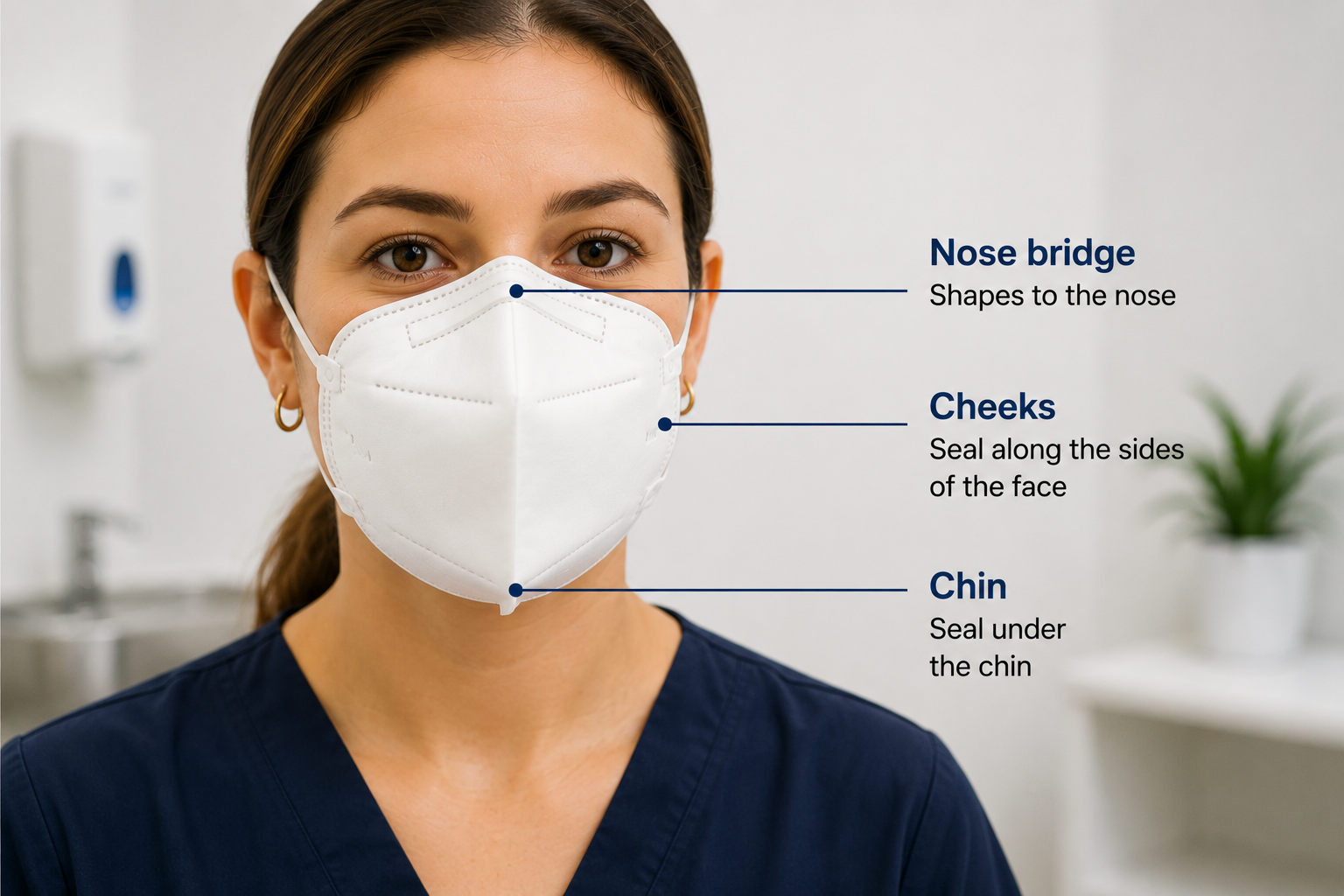
Nose, cheeks and chin all matter
People often focus only on the nose wire. It is important, but the whole sealing perimeter matters. A respirator can appear secure at the nose yet still leak at the cheeks or under the chin.
Why the same respirator does not fit everyone
Human faces vary enormously. Width, length, nose shape, cheek structure and chin profile all influence how a tight-fitting respirator sits. The dimensions printed on a box can help describe a product, but they cannot tell you with certainty whether it will seal adequately on an individual face.
Respirator geometry matters as well. A cup-shaped model holds a preformed shape, while flat-fold and multi-panel respirators unfold around the face in different ways. Some wearers prefer more space in front of the mouth; others achieve a better fit from a smaller or differently shaped design.
What is respirator fit testing?
Fit testing is a formal procedure used to assess whether a particular tight-fitting respirator adequately fits an individual wearer. WorkSafe Victoria says fit testing is needed before tight-fitting RPE is worn for the first time when it is being used as a risk control, and recommends regular re-testing as well as re-testing after facial changes such as significant weight change or surgery.
There are two broad approaches:
- Qualitative fit testing is a pass/fail method in which the wearer detects a test agent, commonly through taste or smell, if leakage occurs. It has limitations and is only suitable for particular negative-pressure respirators and test circumstances.
- Quantitative fit testing uses specialised equipment to objectively measure leakage and produces a numerical fit factor. WorkSafe Victoria describes quantitative testing as the preferred method because it provides a precise, objective and repeatable measurement.
A fit-test result relates to the particular make, model, style and size tested on that individual. Passing in one model should not be assumed to mean another model will fit equally well.
What is a fit check?
A fit check is the wearer's check that the respirator has been put on and positioned correctly. For tight-fitting negative-pressure respirators, it should be carried out each time the respirator is worn, following the manufacturer's instructions.
The exact method varies by respirator. WorkSafe Victoria describes a negative-pressure check in which the wearer blocks the filter inlet where appropriate, inhales gently and observes whether the facepiece remains slightly collapsed without obvious leakage. Disposable respirator manufacturers may specify a different user-seal-check method, so the instructions supplied with the particular product should always be followed.
A fit check is not a fit test. A successful check each time the respirator is donned is important, but it does not replace formal fit testing where fit testing is required.
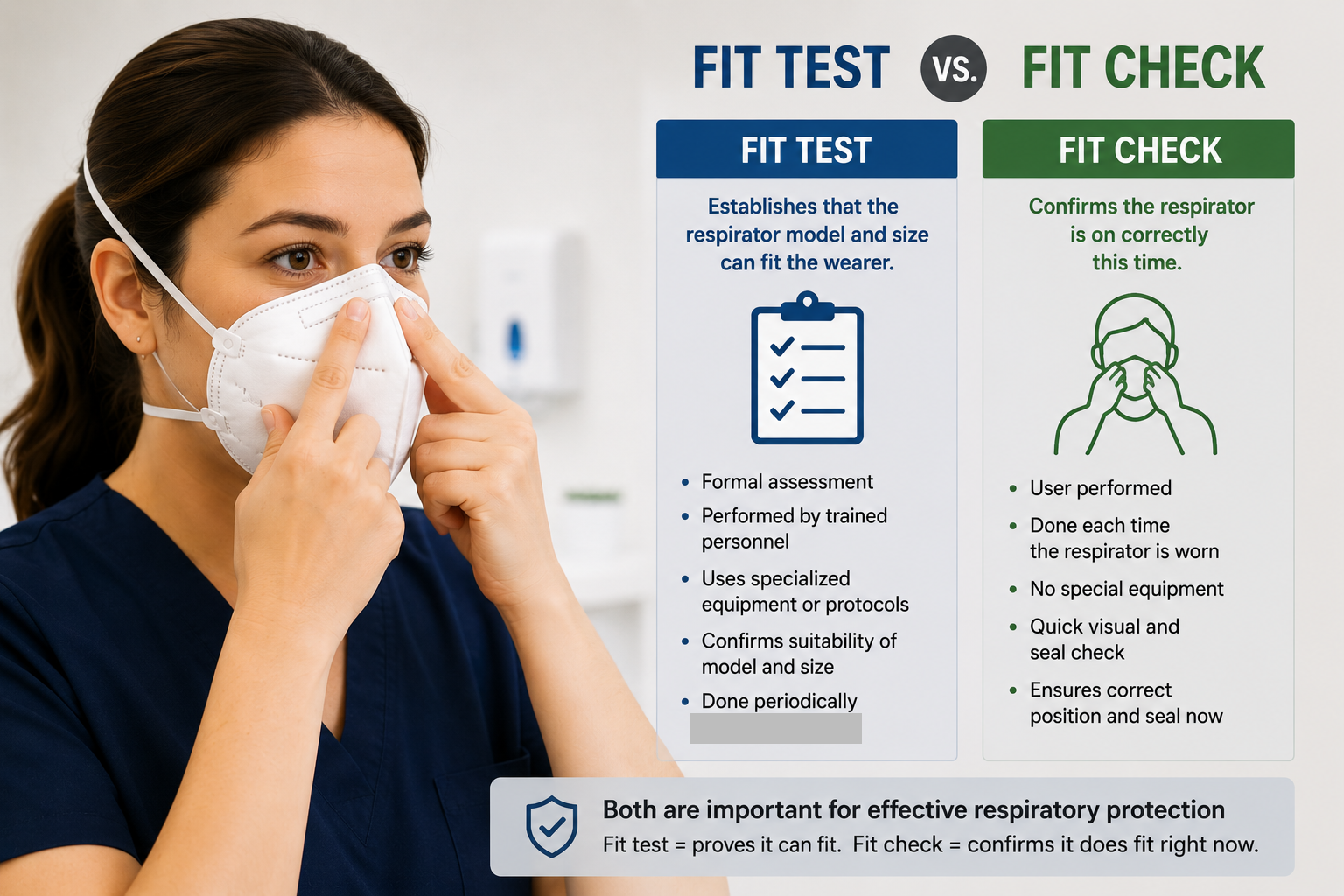
Fit test versus fit check
Think of fit testing as establishing that a particular respirator model and size can fit the wearer, while the fit check confirms that the wearer has put that respirator on correctly on this occasion. Both have a role; they are not interchangeable.
Facial hair and the sealing surface
Hair trapped beneath a tight-fitting respirator's sealing surface can create leakage paths. WorkSafe Victoria specifically identifies stubble, beards, sideburns and moustaches extending into the sealing area as factors that can interfere with the seal.
For workers required to use tight-fitting RPE, being clean-shaven where the respirator seals is therefore not merely a cosmetic preference. If a person cannot shave for medical, religious or cultural reasons, the workplace still needs to manage the respiratory hazard and may need to consider an alternative such as appropriate loose-fitting powered RPE that does not rely on a face seal.
Glasses and other PPE
Eyewear, face shields, hearing protection, helmets and other PPE can affect how a respirator sits. Glasses should not be trapped beneath a sealing surface, and other equipment should not displace the respirator or interfere with its straps.
Fogging of glasses can sometimes indicate upward airflow, although fogging by itself is not a formal fit test and can have several causes. If leakage is suspected, stop and check the respirator according to the manufacturer's instructions and workplace procedure.
Movement matters
A respirator that appears to fit while someone stands still still needs to remain appropriately positioned during realistic movement. Formal fit-test protocols commonly include movements such as talking and turning the head because these can challenge the seal.
This is particularly relevant for jobs involving frequent bending, speaking, lifting or looking up and down. Strap tension that feels adequate initially may behave differently after extended wear or movement.
When should fit testing be repeated?
WorkSafe Victoria recommends annual re-testing and also identifies circumstances where re-testing is needed because the wearer or respirator has changed. Examples include substantial facial change, weight loss or surgery, or moving to a different respirator model or size.
Your workplace's respiratory protection program may impose additional requirements, so follow the program applying to the task.
What if a respirator fails the fit test?
A failed fit test does not necessarily mean the wearer cannot use respiratory protection. It means that particular respirator did not demonstrate an adequate fit under the test. WorkSafe Victoria recommends trying different types, shapes and brands. If a suitable tight-fitting option cannot be found, RPE that does not rely on the same facial seal may need to be considered.
This is one of the strongest reasons not to treat a single respirator model as universally suitable.
A simple fit and sizing checklist
- Read the manufacturer's sizing and donning instructions.
- Make sure the respirator covers the nose and mouth and sits correctly under the chin.
- Position straps exactly as instructed rather than modifying them for convenience.
- Mould an adjustable nosepiece using the manufacturer's recommended technique.
- Keep hair, jewellery and clothing out of the sealing surface.
- Perform the specified fit check every time a tight-fitting respirator is worn.
- Do not assume a fit check replaces formal fit testing.
- If a model repeatedly leaks or shifts, investigate another size or design rather than simply tightening it excessively.
- For workplace RPE, record and use the exact make, model, style and size for which the wearer has achieved the required fit.
Frequently asked questions
Does “one size fits most” mean fit testing is unnecessary?
No. A retail sizing description does not establish an adequate seal on an individual wearer. Where workplace fit testing is required, the particular model and size still need to be tested on the wearer.
Can I fit test myself at home?
A casual home check is not equivalent to a formal workplace fit test. WorkSafe Victoria says fit testing should be conducted by a person with appropriate knowledge and experience using a recognised method.
Why does my respirator leak around my nose?
Possible reasons include incorrect positioning, an inadequately moulded nosepiece, the wrong size or shape, strap position, facial hair, or incompatibility with eyewear. Follow the manufacturer's instructions and, for workplace RPE, raise persistent fit problems through the respiratory protection program.
Does a beard really make a difference?
Yes where hair lies beneath the sealing surface of tight-fitting RPE. Even stubble can interfere with the face seal. Loose-fitting RPE that does not rely on a facial seal may be an alternative in some workplace situations.
Explore your options
See our current respirator range to compare available designs. You can also read our general respirator selection guide or learn about transparent masks and communication. If you have a product question before ordering, contact us.